It's been a while since my last post! Birding (and biking) has slowed down due to bad weather and flu. I managed to cover my small section for the Christmas Bird Count by bike, though. We had by far the best weather out of the three years I've participated in the CBC here, so it was a nice day to be out. Most unexpected for my small, suburban section were a Red-tailed Hawk and American Kestrel - neither is at all rare in the area, but I don't usually see them in my section. I was also pleased to find a pair of Red-breasted Nuthatches at the Onalaska cemetery, which is full of various conifers.
Red-breasted Nuthatches are irrupting south this year in a big way, due to poor food availability farther north, but this is one of the few areas in the count circle where I've reliably found them (they were even there last winter, pre-irruption). This guy was trying to find somewhere to cache a small seed.
One of the small parks in my section - a fishing access area that isn't an eBird hotspot but is my favorite hidden local gem, and just a few blocks from home - yielded all five woodpecker species in the space of a few minutes, so that was fun: Red-bellied, Downy, Hairy, Pileated, and Yellow-shafted Flicker. There's an outside chance of Yellow-bellied Sapsucker here in winter, but none were found this year. Other birders in the count circle found several very late-lingering migrants, including our CBC's second-ever record of a Ruby-crowned Kinglet (common during short migration windows, but not now), and the Baltimore Oriole must have been similarly unusual.
Otherwise, I did very little birding for about three weeks! I caught the flu despite having dutifully gotten a flu shot, and while it wasn't too bad (and not as bad as Lyme disease!), I was really low on energy for a surprisingly long time. I think I'm finally recovered now - just in time to do some birding yesterday before leaving for a holiday trip today.
I decided to head south into the next county, where two Long-tailed Ducks had been reported on the Mississippi two weeks ago - a very unusual species to find around here. The two previous reports were by two birders whom I don't know, and while the descriptions sounded pretty good, there weren't photos - so I wondered a bit if the identification had been correct in the first place. (The fact that I don't know those birders means my doubts were definitely nothing personal!) Two weeks would be a long time for any bird to stick around, too, but I knew my chances of finding them would only get smaller as the winter progresses and the water freezes further. Waterfowling is fun in any case, and I would have some options to stop and scope at additional places on the way back if the Long-taileds didn't turn up where previously reported, so it seemed like a worthwhile outing.
Unfortunately, getting there meant biking all through the city of La Crosse (from my home in the northern suburb of Onalaska). There's no direct route through the city that's safe for bikes, and while the indirect route is (mostly!) signed with directions for bikes, there's a couple of annoying intersections and plenty of opportunity to lose the route. That's why I've never actually gone birding south of town before - despite Goose Island, the county's most diverse hotspot, being <15 miles from home.
Yesterday's trip took me a couple of miles past Goose Island - so I've still never birded there! - to a few parking areas on the side of the highway. The parking areas are well separated from the highway, and I could even get entirely off the pavement in all three places, either on the grass or on this convenient platform:
I love having overcast skies when scoping waterbirds - no glare, no backlight, and less thermal distortion off the water. There was only a light breeze, which was enough to keep me on the cold side (temperatures were in the upper 20s F and I always freeze the moment I stop biking - but I put on my down suit and warmed up after about an hour of scoping), but not enough to interfere with birding, so conditions were pretty ideal - especially for winter. (No snow on the roads, either!)
There was plenty of open water to scope, as perhaps you can see in the above photo, but not a whole lot of ducks. The Long-taileds had been reported with Common Goldeneyes, so I was checking those small groups carefully. However, the previous reports had also noted several dozen Canvasbacks - which were no longer present... so I wondered if the Long-taileds might have left too.
But within a few minutes at the second overlook - there they were! Long-tailed Duck for #237!


I couldn't believe they were still there! They were pretty distant from the second parking area (my scope is pointing at them on the platform pictured above), but identifiable. I was happy to find that they were much closer to the third overlook, where I took the above digiscoped pictures (which are clearly nothing to brag about - the ducks were still pretty far out). Long-tailed Ducks are accomplished divers, and when these two were foraging, they dove together and stayed underwater more than above. That made them tough to keep track of, especially when trying to get my camera on them through the scope. But I was thrilled to get photo documentation of this local rarity - not to mention my first FOGY in six weeks! This is only the second time Long-tailed Ducks have been recorded in Vernon County in eBird, and there are only three records in somewhat-more-frequently-birded La Crosse County just to the north.
The end of the year is looming near, especially as I'll be out of state most of this week. Fingers crossed that the weather allows for a couple of birding trips next weekend, and I might take Monday the 31st off work for a last-ditch effort (or maybe, as a federal employee affected by the current shutdown, I will still be on furlough then...). I'd love to try for Eastern Screech-Owl, which would be a lifer - but I can't safely bike to the place that is currently most reliable for them, so I'll have to try my luck somewhere else. Hopefully I can also try again for Northern Shrike, which seems to be my nemesis for the year! I might have a chance at finding a Golden Eagle, and maybe I'll really luck out and come across a flock of Snow Buntings along the way... but otherwise, the remaining options for the year are pretty sparse. But you never know what will turn up until you get out there and look!
I've been out waterfowling a couple of times since my last post, including a long day (or as long as you can get from sunrise to sunset this time of year) biking to, through, and back from Trempealeau National Wildlife Refuge. That refuge is a nice spot for ducks, with a variety of other habitat. Much of the refuge is accessible along several dikes where you can walk or bike, but not drive, and they're each a couple miles long, so a bike is a perfect way to bird there. Alas, there were no Snow Buntings on the dike that hosted two for at least a week at this time last year. I didn't bring enough food with me that day, and by the time I got home (56 miles later), I was beat! I seem to need a regular reminder that calories are crucial...
Today I headed to another area of Trempealeau County - the agricultural fields north of the town of Trempealeau. It's the biggest stretch of open, flat ag land around here, presumably providing the best chance of birds like Snow Buntings and Lapland Longspurs, and maybe a chance of a Northern Shrike in the shrubby edge stuff. Snowy Owls should also be possible at this time of year, and maybe Short-eared if I'm ever there late enough in the day for them to start foraging. Pipits seemed possible there, but it's getting toward the end of their migration through the area, and they are always sparse at best around here. So all of those species would be pretty long shots. I'd covered this area last fall and this spring without finding anything of note, so my expectations were low for today. It was a good day for that route, though, with a forecast for a tailwind both ways! I also wanted to put on some miles to test my knees and cold-weather gear in case the weather and my schedule allow a longer trip in the next few weeks.
Winter is definitely starting to make itself felt here. We had a dusting of snow the other night, which resulted in slick-ice roads the next morning (three cheers for studded bike tires, bright lights, and bike lanes or a wide shoulder throughout my commute!), but the roads were dry by the end of that day. It's still chilly, though, with temperatures 30-35 F today (several degrees colder with wind chill, but biking with a tailwind takes care of that!). I was glad I'd brought a thermos of hot water today, and my down jacket/pants for when I was biking slowly and stopping frequently to look for birds.
The ag fields typically don't have a lot of bird activity, which means that every bird spotted in that area is a nice surprise. I enjoyed the flocks of American Tree Sparrows, a couple of Bald Eagles and Red-tailed Hawks, a Hairy Woodpecker that I initially tentatively ID'ed by the flight silhouette and was pleased to have it confirmed when it called (I'd already seen/heard several Red-bellied but something about the silhouette seemed wrong for that species), and noisy Blue Jays. A couple of fields were freshly tilled or manured, so I stopped at those to give them a careful look, as those seem to be the most attractive to birds. The roads out there are so quiet that I usually didn't even have to move off the road when I stopped, and I had plenty of warning when a car was coming so I could move over.
Toward the end of the route, I stopped at a freshly tilled field, but couldn't see or hear anything in it. As I started off again, though, three birds popped up and then back down at the edge of the field. The usual suspect in a place like that would be Horned Lark, which can be abundant here. But those calls did not sound quite right for a Horned Lark! I'd studied up on pipit calls and these sure sounded good. I grabbed my brakes and got my binoculars on them as quickly as I could. American Pipits for #236!
I'm still figuring out how well my new camera deals with various settings, and learned a couple of things not to try today... but at least the birds are identifiable. Definitely need to bump up the f-stop (I have many photos like the above but worse, where only a thin layer of cornstalk debris is in focus), but not so far that the shutter speed goes down to 1/40, unless the bird is sitting still (like in the photo below).
I was especially glad for the quiet roads while I was standing there trying to get a clear photo of these guys!
Today's ride totaled 42 miles, which seems like a lot for one new species - and a pretty sparse overall species list (just 21 species on my checklists, plus a few more en route). But getting out is always worth it for the experience, fresh air, and exercise, even when I see nothing new at all. The pipits were definitely a nice bonus, though!
On 14 October, a Pomarine Jaeger was reported about 100 miles northwest of here. No, I didn't go haring off on a 200-mile bike ride to find it (birding is not my only job this year, after all!). But I did tour around the north end of French Island the next day to scope out Lake Onalaska, just in case the jaeger was moving down the Mississippi. Alas, no jaeger. While birding that day, I saw perhaps 200 ducks around the lake, and I was wondering when fall waterfowl migration was going to get going.
Well, the next morning, I went to one of the same spots I'd visited the previous day... and about 100,000 ducks had arrived overnight! I counted (roughly) 30,000 of them that were within scope range, sampled that group for species IDs, and estimated the numbers of the rest based on the blurry smudges that I could see way out on the lake (no hope of identifying most of them). It was quite a spectacle. The majority were Canvasbacks, with a good variety of other divers and dabblers as well. Incredible to think that they had all arrived in just one night - a night when the radar was showing relatively low migration activity! There are still tens of thousands on the lake as of this morning, though there's been some turnover in the species.
Photos can't really do justice to something like that, especially when the birds look like a long line of black specks on the water... but here are some views from when a Bald Eagle (or two, or twelve) was flushing flocks on 18 Oct.
I've been waterfowling at least a couple times per week since then, but most of the ducks stay too far out for really good scrutiny. They know exactly where the no-watercraft/no-hunting zone is!
But I did FINALLY find my FOGY Horned Grebe (#234)!
(...with apologies for the terrible photo.) I'd been shocked that I hadn't seen one this spring. However, eBird tells me that this is the first one I've ever recorded in La Crosse County, so I must have only seen (or at least reported) them up at Trempealeau last year, despite my impression that they are fairly common around here during migration.
But the best duck was definitely a Surf Scoter (#235) last weekend!
Also bad photos, but identifiable, especially if you're willing to take my word that there was no white in the wings when it stretched a couple of times. This is only about the 8th Surf Scoter ever reported to eBird in La Crosse County. I actually lucked into one last year, too - I was slightly less shocked this time, but it still wasn't something I could count on finding this year. This bird was among only about 65 ducks on Neshonoc Lake, which was a much easier group to pick through than the tens of thousands on Lake Onalaska! But no sooner had I seen a "scoter sp." than the whole flock took off, and I was so upset! But then I looked again, and no, it hadn't been the whole flock that had left. Five Ruddy Ducks were still there with the scoter sp. that proved to be a Surf (and then a few dabblers came back). It was a great relief to be able to get a positive identification, because a "sp." doesn't count on the list!
Meanwhile, there were Dunlin on the Upper Mississippi bird cam yesterday. I can see the webcam's solar panel from shore, but there is no hope of getting an identifiable Dunlin in my scope from there... and no other shorebird habitat to be found (except maybe that tiny beach by my office). Sigh...
Waterfowl migration continues for the next month or two, and you never know what will turn up here. I'll be looking for more rare seaducks, any loon other than Common, and Snow Geese whenever I can get out. Plus, it's the right time of year to start searching for those darn Snow Buntings, Lapland Longspurs, Northern Shrikes, and Short-eared Owls again!
This morning I went back to check that marsh with the previous Nelson's and LeConte's records. I'd been pessimistic about the current habitat conditions, but I couldn't just give up, it was relatively convenient to stop there before a midmorning appointment.
We've had more rain lately, so there was even more water to slog through this time. An old leak in one of my boots sprung open, and temperatures were hovering just above freezing, so I was wondering if I would end up with only frostbitten toes to show for the morning!
Then, as I finally slogged out of the water onto a drier patch of trail, a very small brown bird flushed off the edge of the trail in front of me. It came out of much shorter grass than the vegetation inhabited by the other sparrows I've been seeing in that marsh... and it flushed at a remarkably close distance... and it sure was small... so that sure was interesting!
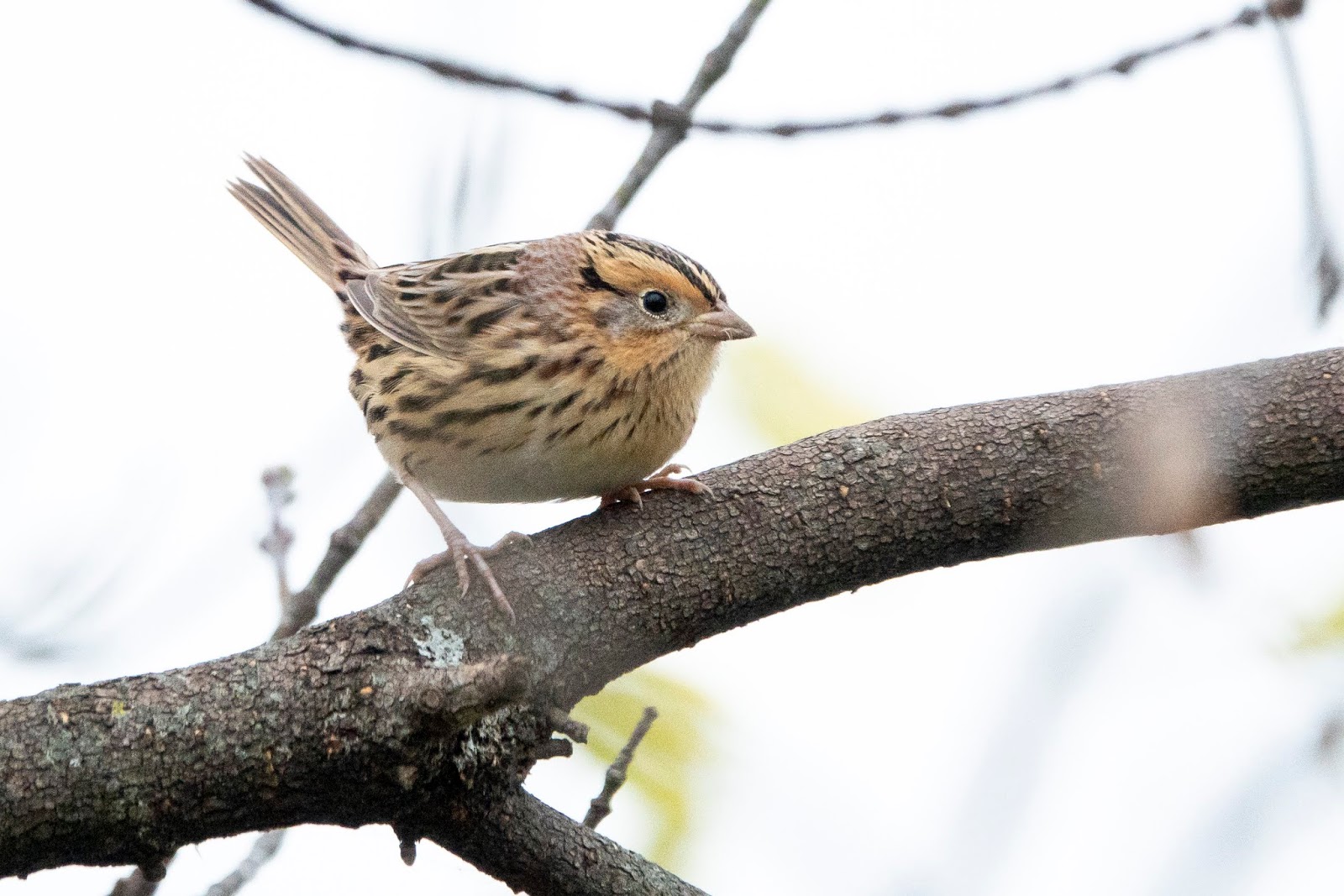
Much to my relief, the bird flew into the base of a stand of forbs where I could see it, just barely. LeConte's Sparrow for #233!
It was fidgeting a bit, but sat in that spot long enough for me to pull out my camera, convince it to focus past all those sticks, and get some identifiable shots. Here you can see the white crown stripe that helps distinguish LeConte's from Nelson's.
Eventually it hopped deeper in to the forbs and I went back to retrieve my gloves from where I'd dropped them on the trail to better handle my camera (just as well that I was out of the flooded part by then!). I walked slowly back toward the patch of forbs, saw a couple of birds flush, walked around to try to get a better look at them (they turned out to be Song and Lincoln's Sparrows)... and then looked up to see the LeConte's in clear view on a tree branch, just above eye level, maybe 15 feet from my face!
That's awfully cooperative for a skulky grassland bird! I couldn't believe my luck. Here you can clearly see the nape, which has fine brownish (Sibley calls them "purple") streaks over a pale gray base. Nelson's would have a plain gray nape. The yellow face with gray cheek patch is also obvious and eliminates any other sparrow; Henslow's has a greenish yellow face but only brown marks (including a dark brown "mustache" that's totally absent here), no gray cheek, and a bigger bill.
I left the bird alone then (it really couldn't get any better than that last photo!) and walked a short distance down the trail before time ran out and I turned around. On my way back through the spot where I'd originally flushed this bird, I again flushed something small and brown off the trail, twice. Both times it flushed at close distances but dove right back down into the short grass, so quickly that I couldn't tell anything more than "small brown sparrow," and there was no way I could see it when it was in the grass. I'm sure it must have been this same bird, and I was SO happy that I'd gotten much better looks the first time!
Here's a view of where it was the first time. It flushed out of the grass in the foreground (short, fresh green stuff that has just recently grown small seed heads), went into that first big stand of forbs in the mid-ground (is that a word?), and then up into the tree on the left.
This is only the second LeConte's to be found in La Crosse County in the history of eBird, so it's extra exciting! (Probably no one really looks for them in most years, though. I only checked this spot once last year.) I put the word out on eBird and Facebook, and several other people went out this afternoon and apparently got nice looks at the bird in this same spot. It's always fun to be able to share a good bird with others!
I would have thought a Nelson's Sparrow would be more likely in this habitat, especially under the current wet conditions, but the best thing about birding is that you never know exactly what will happen next. It's getting to be a little late for Nelson's to be moving through here, but I'll keep looking!